
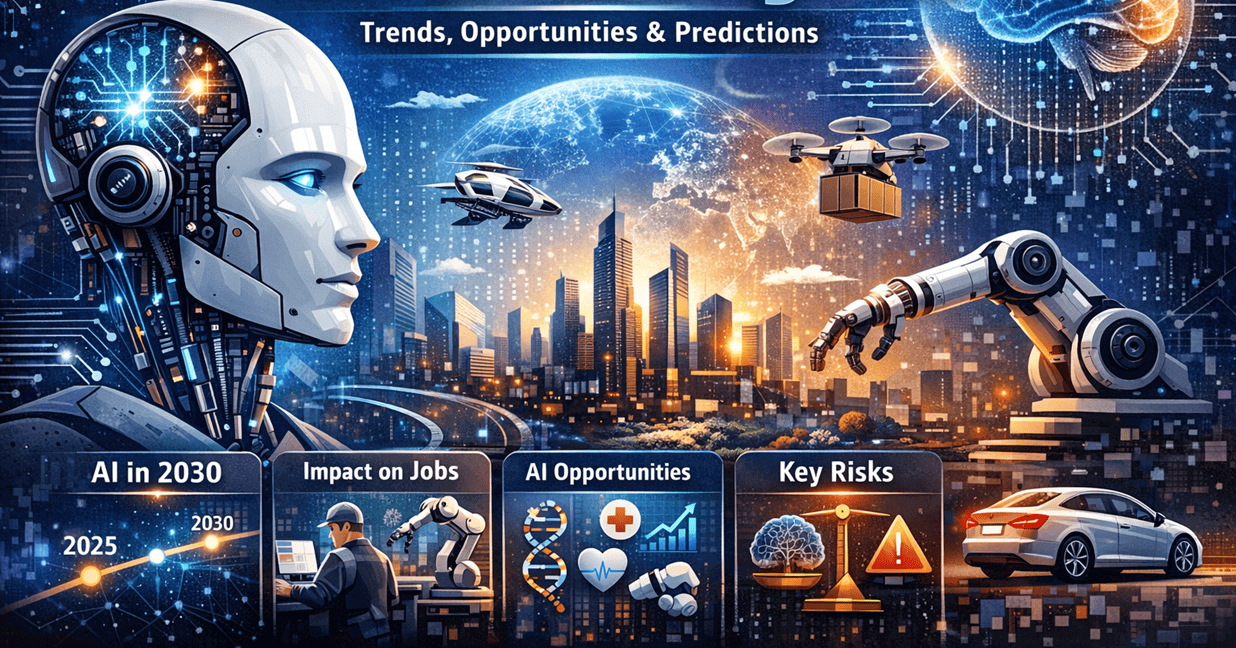
Artificial intelligence has survived its own hype cycle — and that survival tells you something important. After decades of promises and two notable “AI winters” when funding dried up and enthusiasm cratered, the technology is now delivering measurable results in the real world. Not in ten years. Today.
But the discourse around AI still swings between two exhausting extremes: utopian promises of superintelligence solving every human problem, and dystopian panic about machines taking over. Both camps share the same flaw: they substitute narrative for evidence.
This article cuts through the noise. It draws on peer-reviewed research, published industry data, and the track records of actual deployed systems to give you an honest picture of where AI stands, where it is credibly headed, and, critically, what still remains unsolved.
The AI systems deployed between 2020 and 2025 — GPT-4, Gemini, Claude, AlphaFold, Stable Diffusion — have collectively shifted AI from research curiosity to operational technology. The decisions that governments, businesses, and individuals make in the next five years will shape this technology’s trajectory for decades.
Table of Contents
What AI Actually Is (And What It Isn’t)
The term “artificial intelligence” has been applied to everything from a thermostat that learns your temperature preferences to systems that write code, generate photorealistic images, and defeat world champions at chess and Go. This breadth is part of what makes it hard to reason about clearly.
At its technical core, modern AI is predominantly machine learning, systems that improve their performance on tasks through exposure to data, rather than through explicit programming. Within machine learning, deep learning (using multi-layered neural networks) has driven most of the breakthroughs of the past decade.
The Spectrum of AI Capability
Researchers typically distinguish three levels, though only the first currently exists:
- Narrow AI (ANI) — systems designed to excel at specific tasks. Every deployed AI system today falls here. GPT-4 is excellent at language; AlphaFold is extraordinary at protein prediction; neither can do what the other does.
- Artificial General Intelligence (AGI) — a hypothetical system capable of any intellectual task a human can do. No AGI exists. Expert timelines range from 10 years (Demis Hassabis) to “never” (Gary Marcus).
- Artificial Superintelligence (ASI) — a hypothetical system surpassing human intelligence across every domain. This remains speculative and contingent on AGI being achieved first.
Common MisconceptionLarge language models like ChatGPT or Claude do not “understand” language the way humans do. They are extraordinarily sophisticated pattern-completion systems. They can produce text that sounds knowledgeable while being factually wrong — a limitation called “hallucination” that remains an active research challenge.
Why AI Is Advancing So Fast
The acceleration of AI capability since roughly 2012 is not accidental. It is the product of three forces converging simultaneously.
1. Data: The Fuel
Machine learning systems learn from data. The explosion of digital information has given AI systems an unprecedented training resource. The Common Crawl dataset used to train many large language models contains over 250 billion web pages. However, research from 2024 suggests that text-based AI may be approaching limits models may have already been trained on a significant fraction of high-quality internet text.
2. Compute: From GPUs to Trillion-Dollar Industries
Modern AI runs on GPUs originally designed for video games. NVIDIA’s shift toward AI workloads helped make it one of the most valuable companies in the world — its market cap exceeded $3 trillion in 2024. The cost of training frontier models is staggering: training GPT-4 is estimated to have cost over $100 million. This concentrates AI development in a small number of well-funded organizations.
3. Algorithmic Innovation
Perhaps the most underappreciated driver. The transformer architecture, introduced in the 2017 paper “Attention Is All You Need” by Vaswani et al., enabled the current generation of large language models. Reinforcement learning from human feedback (RLHF) made those models safer and more useful to deploy. These algorithmic leaps produce dramatic capability gains independently of data or compute.
Five AI Trends That Actually Matter
1. Multimodal AI
The most significant shift in recent AI development is the move from single-modality systems to multimodal systems that process and generate text, images, audio, video, and code simultaneously. GPT-4o, Gemini 1.5, and Claude 3 Opus all operate across modalities. This matters because the real world is inherently multimodal — a system that reads a medical scan and describes its findings in natural language is far more useful than one that can only do one or the other.
2. AI Agents and Autonomous Workflows
The next frontier is not just AI that answers questions, but AI that takes actions — browsing the web, writing and executing code, booking appointments, orchestrating complex workflows. These agentic systems are in early deployment today. However, several high-profile failures in 2024 demonstrated that autonomous AI agents can make consequential mistakes without adequate oversight.
3. AI in Scientific Discovery
AlphaFold 2, developed by Google DeepMind, predicted the 3D structure of virtually every known protein — a problem that had occupied structural biologists for 50 years. The database of predicted structures has been accessed by over a million researchers. DeepMind’s AlphaProof demonstrated PhD-level mathematical reasoning in 2024. AI as a tool for scientific discovery may prove to be its most consequential long-term application.
4. The Regulatory Landscape Shifts
The EU AI Act, which came into force in 2024, establishes the world’s first comprehensive AI regulatory framework — categorizing systems by risk level and imposing corresponding obligations. The U.S. approach remains fragmented: sector-specific guidance, executive orders, and voluntary commitments. China has implemented its own regulations, including requirements to label AI-generated content. This global fragmentation creates compliance complexity for multinational organizations.
5. The Energy and Infrastructure Challenge
A largely underreported story: AI is driving a significant increase in electricity consumption. A single ChatGPT query consumes roughly 10 times the electricity of a Google search. The International Energy Agency projects data center electricity consumption could double to 1,000 TWh by 2026 — comparable to Japan’s total electricity use. Microsoft, Google, and Amazon have all signed agreements for nuclear power to support their AI data centers.
Underreported RiskThe energy cost of AI is not a footnote — it is a fundamental constraint on how fast the technology can scale, and it has serious implications for climate commitments. Organizations evaluating AI adoption should factor infrastructure and energy costs into their analysis.
How AI Is Transforming Industries: Real Evidence
| Industry | Documented Impact | Key Limitation | Disruption Level |
|---|---|---|---|
| Healthcare | AI detects breast cancer with fewer errors than radiologists (Nature Medicine, 2023). Med-PaLM 2 passes USMLE. | Slow clinical deployment due to regulation and liability | High |
| Finance | AI drives ~60-75% of U.S. equity trading volume. Reduced credit card fraud losses significantly. | Flash Crash risk; systemic interaction failures at scale | High |
| Education | Khan Academy’s Khanmigo shows early promise in personalized tutoring | Assessment disruption; gap between promise and scaled deployment | Medium |
| Climate Science | GraphCast makes 10-day forecasts faster and more accurately than traditional models | AI’s own energy footprint complicates sustainability claims | Medium |
| Legal | Document review and contract analysis dramatically accelerated | Hallucination risk in high-stakes legal work remains serious | Medium |
AI and Work: A More Honest Accounting
The question of AI’s impact on employment generates more heat than light. The honest answer: we are in early innings and the evidence is genuinely mixed.
Goldman Sachs estimated in 2023 that AI could automate 25% of work tasks across the U.S. economy, with the highest exposure in legal and administrative roles. McKinsey estimates 12 million workers may need to switch occupational categories by 2030.
Goldman Sachs Global Investment Research (2023) & McKinsey Global Institute (2023)
These projections have important caveats. Automating a task is not the same as eliminating a job — most jobs consist of many tasks, only some of which are automatable. Historical precedent suggests that technology-driven productivity gains tend to create demand for new categories of work, often in ways that are difficult to predict in advance.
Skills That Will Hold Value
- Judgment under uncertainty — AI systems are confident even when wrong. Recognizing when a situation falls outside the training distribution is a distinctly human capability.
- Contextual and social intelligence — navigating organizational dynamics, building trust, reading a room. These require embodied human experience that current AI cannot replicate.
- Novel problem formulation — AI excels at solving well-defined problems. Identifying which problems are worth solving, and how to frame them, remains a human contribution.
- AI collaboration fluency — the ability to effectively direct, evaluate, and course-correct AI systems. This is increasingly a core professional skill, not a nice-to-have.
Risks That Demand Honest Attention
Bias and Discrimination
AI systems trained on historical data encode historical biases — and this is not theoretical. Amazon scrapped an AI recruitment tool in 2018 after discovering it systematically downgraded women’s resumes. The COMPAS recidivism prediction tool was found by ProPublica to be nearly twice as likely to falsely flag Black defendants as high-risk compared to white defendants. Active intervention — diverse development teams, bias auditing, deployment monitoring — is required.
Misinformation at Scale
Generative AI has dramatically lowered the cost of producing convincing false content. The 2024 election cycle in multiple countries provided early evidence of this in practice. The challenge is not only detecting individual pieces of synthetic media — it is the systemic erosion of epistemic trust when people can no longer default to trusting their senses.
Safety and Alignment
As AI systems become more autonomous, ensuring they reliably pursue intended goals — rather than proxy goals that look similar during training but diverge in deployment — becomes central. This is the “alignment problem.” Geoffrey Hinton, who won the 2024 Nobel Prize in Physics for his foundational neural network work, left Google in part to speak freely about AI risks. That one of the field’s founders considers safety risks credible and serious is itself significant data.
Concentration of Power
AI development is concentrating in a small number of large companies — primarily Google, Microsoft/OpenAI, Meta, Amazon, and Anthropic in the U.S., and Baidu, Alibaba, and Huawei in China. This creates accountability risks: technology shaping information access and hiring decisions is being developed by organizations with particular commercial incentives and limited democratic oversight.
AGI: What We Know, What We Don’t
Optimistic researchers point to the rapid capability gains of large language models as evidence of a scaling trend that may continue toward general intelligence. Sam Altman has suggested AGI could arrive within a few years. Demis Hassabis has given a 10-year horizon. These are not random guesses — they are informed predictions from people at the frontier of the field.
Skeptics note that current AI systems, despite impressive benchmark performance, fail in ways that suggest fundamental gaps. LLMs still hallucinate, still fail at simple logical tasks humans find trivial, and still cannot learn efficiently from small amounts of new information the way humans do. Gary Marcus and others argue the path from current systems to AGI requires conceptual breakthroughs, not just scale.
The Honest PositionWe do not know when AGI will arrive, whether current architectural approaches will achieve it, or what it will look like when it does. Anyone who claims certainty on these questions is overconfident. What is reasonable: take the possibility seriously enough to do safety research now, while not letting speculative scenarios distract from the concrete impacts of current narrow AI.
The Geopolitical Dimension
One of the most significant omissions in mainstream AI coverage is geopolitical context. AI is not developing in a neutral global environment. it is developing within intensifying strategic competition, primarily between the United States and China.
The U.S. government imposed sweeping export controls on advanced semiconductors and chip-making equipment to China in 2022, and tightened in 2023 — an unprecedented technological containment effort. China has responded by accelerating domestic semiconductor development. The outcome of this competition will shape which AI capabilities exist and who controls them.
The EU’s regulatory approach represents a third model: one that prioritizes rights protection over raw capability development. How these three approaches interact will shape global AI governance for decades.
How to Actually Prepare
For Individuals
- Develop AI fluency, not just familiarity — there is a difference between using a chatbot and understanding its capabilities and limitations well enough to direct it effectively.
- Learn prompt engineering and AI collaboration as a core professional skill, the way spreadsheet literacy became essential in the 1990s.
- Focus skill development on capabilities hardest to automate: judgment, communication, and domain expertise deep enough to critically evaluate AI outputs.
- Stay current on AI developments in your specific field — general AI news is less useful than deep coverage of AI in your domain.
For Organizations
- Audit your processes for AI automation potential before your competitors do. Early operational experience with AI tools creates compounding advantages.
- Invest in AI governance infrastructure — not just to comply with regulation, but because unmonitored AI deployments create real operational and reputational risks.
- Be realistic about implementation timelines. AI deployments consistently take longer and require more change management than anticipated.
- Prioritize data quality. AI is only as good as the data it is trained or fine-tuned on. Organizations with clean, well-structured proprietary data have a meaningful advantage.
Artificial intelligence is neither the magic solution its boosters promise nor the existential threat its critics fear. It is a powerful, rapidly developing, genuinely consequential technology reshaping significant domains of human activity in real time — with more changes coming. The most useful orientation: informed engagement. Understand what current AI can and cannot do. Pay attention to evidence. Make deliberate choices. The future of AI will be shaped by the accumulated decisions of millions of people — including you.
Is AI going to take my job?
Possibly some of your tasks, probably not your entire job, and likely not immediately. The realistic near-term scenario is that AI changes what your job involves — automating routine elements and shifting human attention toward higher-judgment work. The medium-term picture is more uncertain and varies significantly by occupation. Workers performing repetitive, routine cognitive tasks face greater displacement risk than those in roles requiring physical dexterity, interpersonal skills, or creative judgment.
What’s the difference between the EU AI Act and U.S. AI regulation?
The EU AI Act is a comprehensive, risk-based regulatory framework with legal force — systems classified as “high risk” in employment, education, or law enforcement face mandatory requirements. The U.S. approach has been fragmented: sector-specific guidance, executive orders, and voluntary company commitments. The U.S. lacks comprehensive AI legislation comparable to the EU Act as of early 2025.
What is the carbon footprint of AI?
Significant and growing. The IEA estimates data center electricity consumption could double to 1,000 TWh by 2026, driven substantially by AI workloads — comparable to Japan’s total electricity consumption. Individual model training runs vary widely; estimates for training GPT-4 range from hundreds to thousands of metric tons of CO₂ equivalent. A single ChatGPT query uses roughly 10× the electricity of a Google search.
Can AI be truly creative?
AI can produce outputs that humans find creative — novel images, music, writing, and code that can be aesthetically compelling and technically impressive. Whether this constitutes “real” creativity depends on how you define the term. What is clear: AI-generated content is challenging assumptions about creativity as an exclusively human capacity and disrupting creative industries in ways still playing out.
Where should I read to stay current on AI?
For technical depth: Anthropic’s research blog, DeepMind’s publications, arXiv (cs.AI section). For policy implications: MIT Technology Review, The Gradient. For critical perspectives: Gary Marcus’s Substack. For business implications: McKinsey’s AI research and Harvard Business Review’s AI coverage. Primary sources, actual papers, and company announcements, are often more accurate than secondary coverage.
Goldman Sachs (2023)The Potentially Large Effects of AI on Economic GrowthWorld Economic Forum (2023) Future of Jobs ReportMcKinsey Global Institute (2023) The Economic Potential of Generative AIVaswani et al. (2017) Attention Is All You Need — NeurIPSJumper et al. (2021) Highly Accurate Protein Structure Prediction — NatureAngwin et al. (2016) Machine Bias — ProPublicaIEA (2024) Electricity 2024: Analysis and Forecast to 2026EU AI Act (2024) Official Journal of the European Union

